The Redis browser that starts with one command.
Browse and edit keys of every type, run commands in a console, and watch live server stats. redisdeck runs wherever Node does and opens in any browser.
npx redisdeck redis://:password@host:6379Free and open source, MIT licensed. Needs Node.js 20 or newer.
- SCAN, not KEYS
- safe to browse a busy server
- 7 data types
- each with its own editor
- 1 command
- no install, no config, no account
- rediss://
- TLS, passwords and ACL users
Every type, edited the way it’s shaped.
Not a raw string dump. Each data type gets an editor that fits it, and big collections load page by page.
- STRString
- HASHHash
- LISTList
- SETSet
- ZSETSorted set
- STREAMStream
- JSONRedisJSON
Find any key
Search by text or a glob pattern like user:*, and filter by type. Listing uses SCAN, so it never blocks the server.
TTL at a glance
Every key shows its type and time to live. Set or remove an expiry without typing a command.
Key actions
Create keys of any type, rename them (never overwriting another), and delete.
A console that feels like redis-cli
Run any command with Tab completion, output shaped like redis-cli, exact integers and ↑/↓ history.
Live server stats
Operations per second, memory, network and clients, cache hit ratio, keyspace per database and the slow log.
Every logical database
Switch between db0 and db15, or however many the server has, from the header.
Binary safe
Keys and values that aren’t UTF-8 are shown escaped (\xff) and never corrupted by an edit.
Read-only that holds
With --readonly the console only runs commands Redis itself flags as read-only, using COMMAND INFO.
Light and dark
Follows your system, or pick one. Type badges and charts are tuned for both.
Take the tour.
Real screens from redisdeck, running against a demo shop cache.
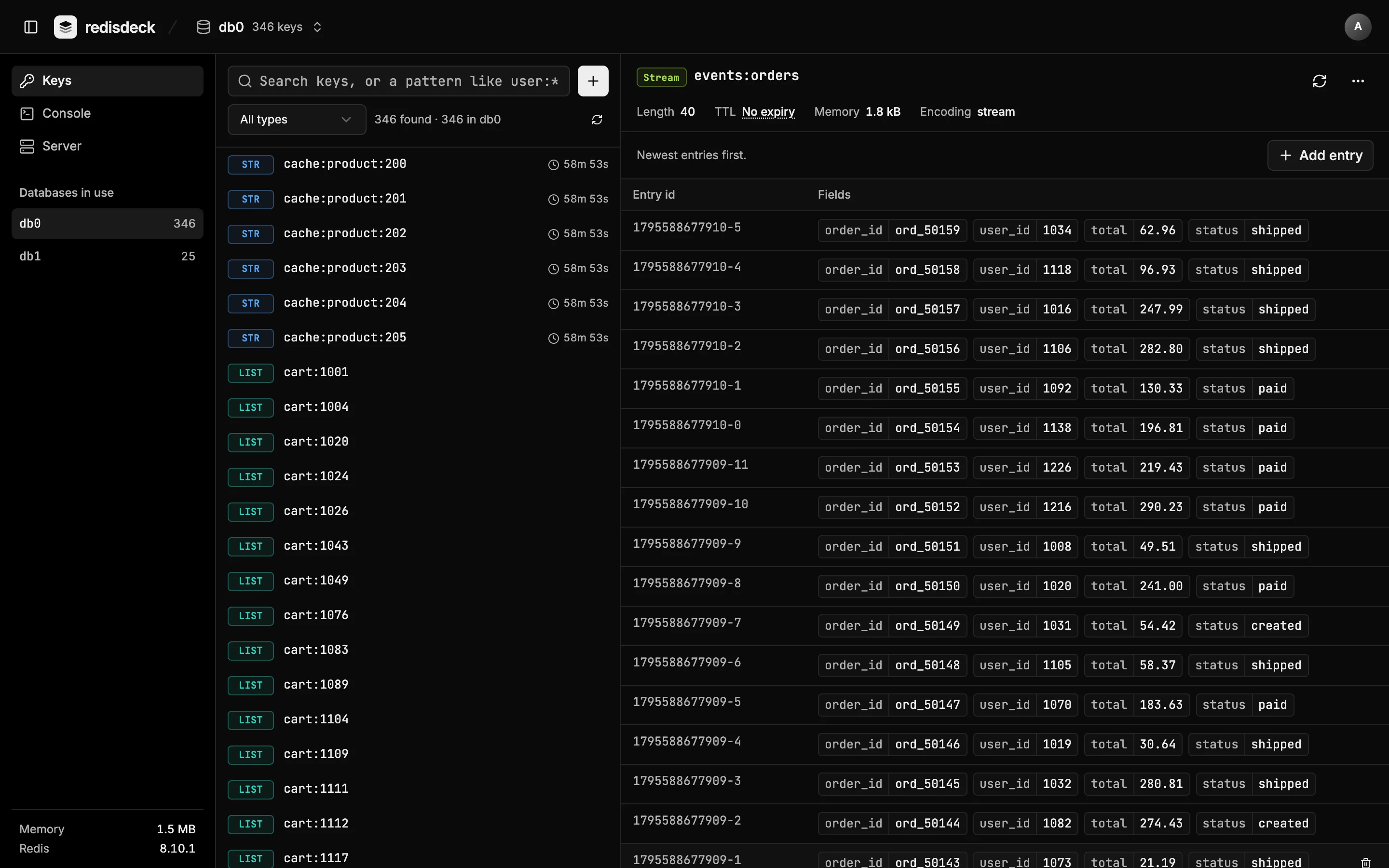
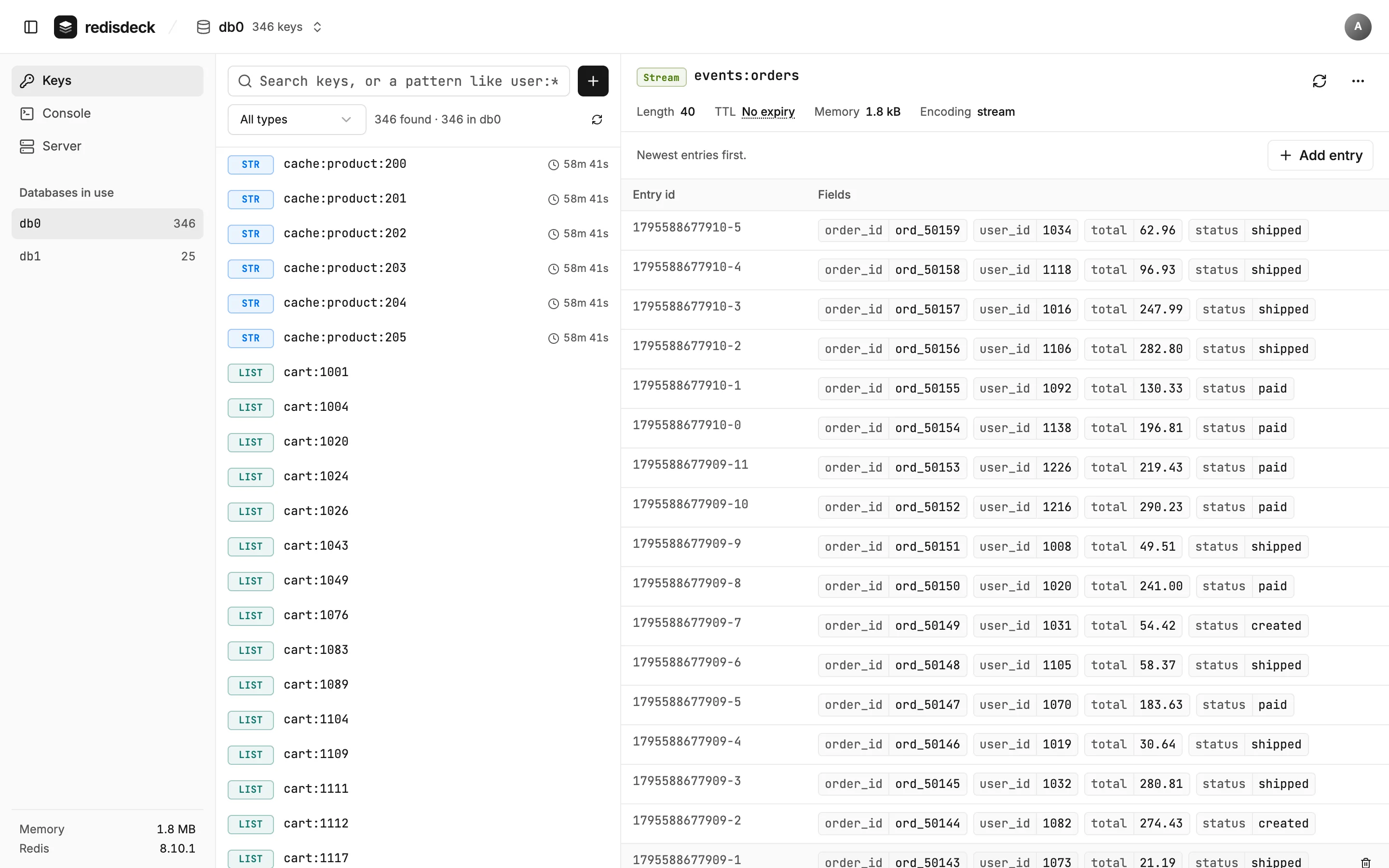
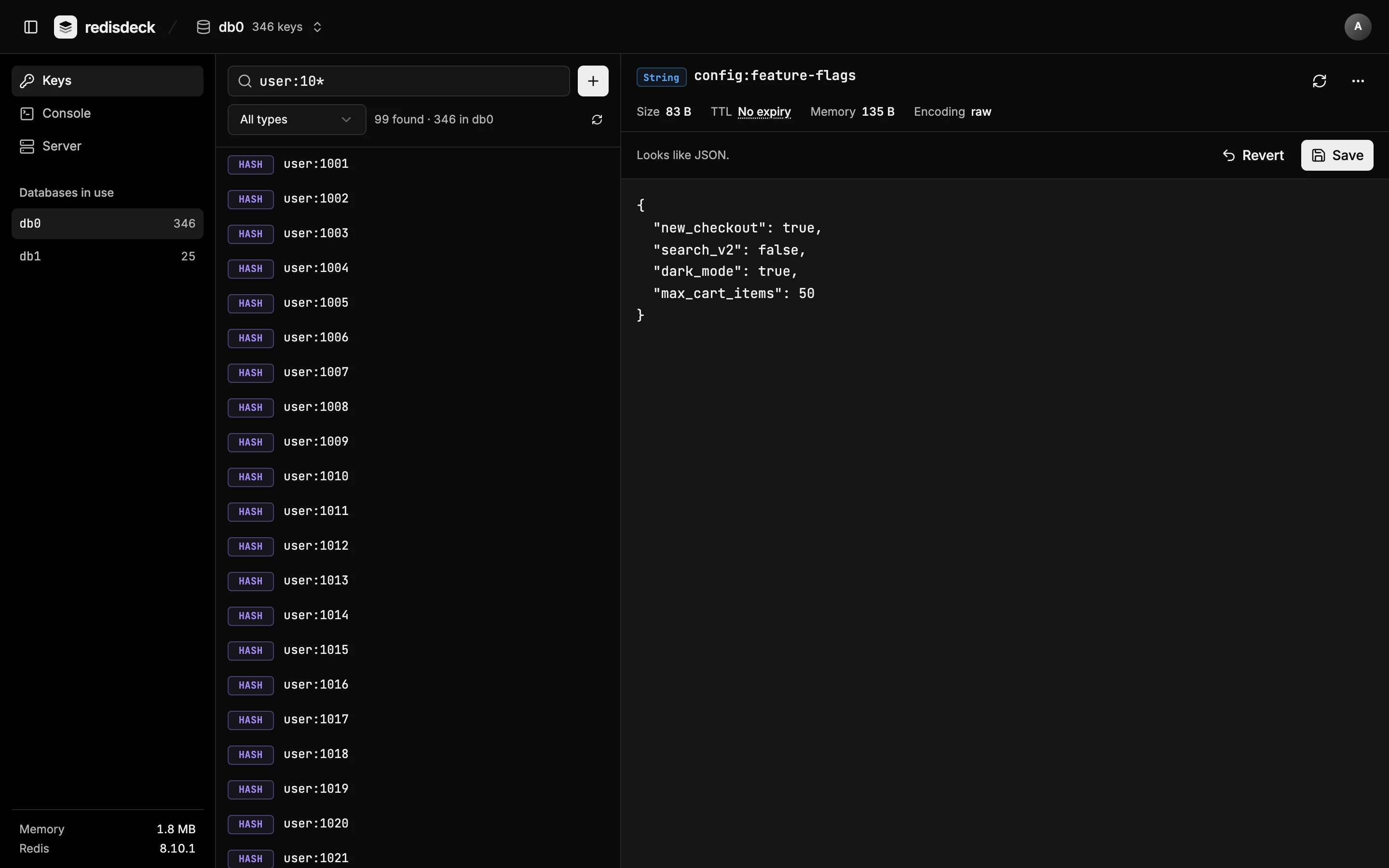
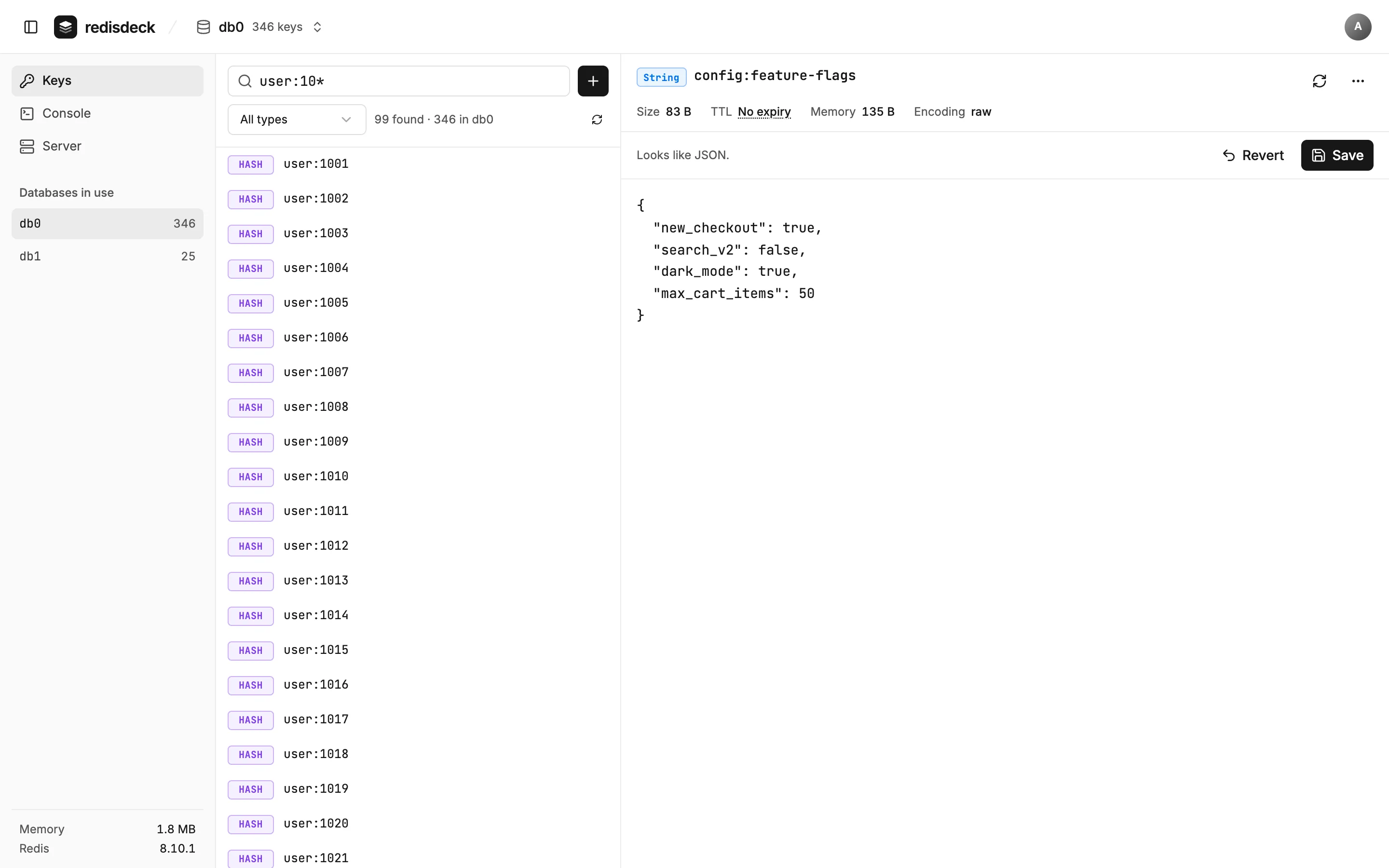
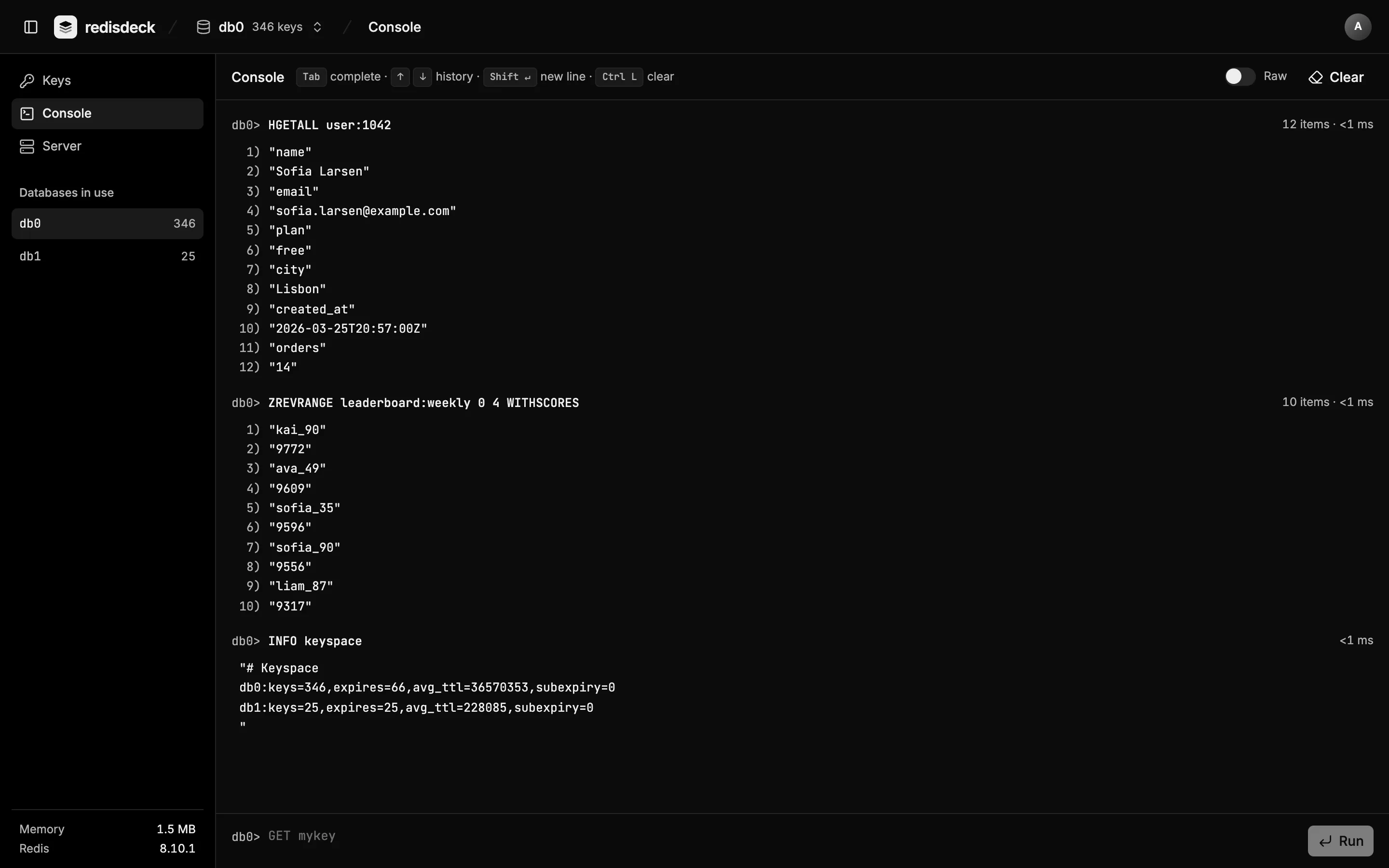
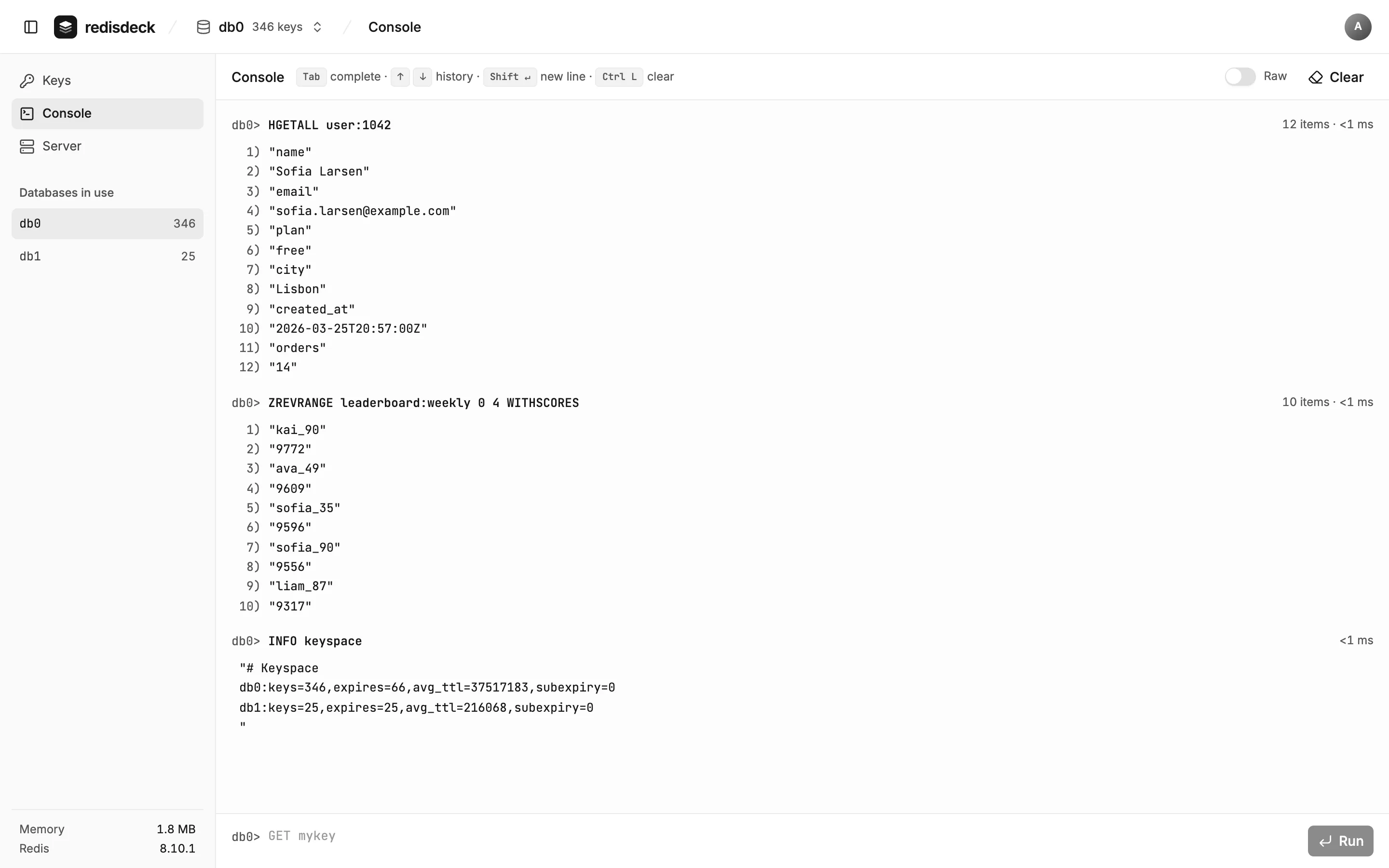
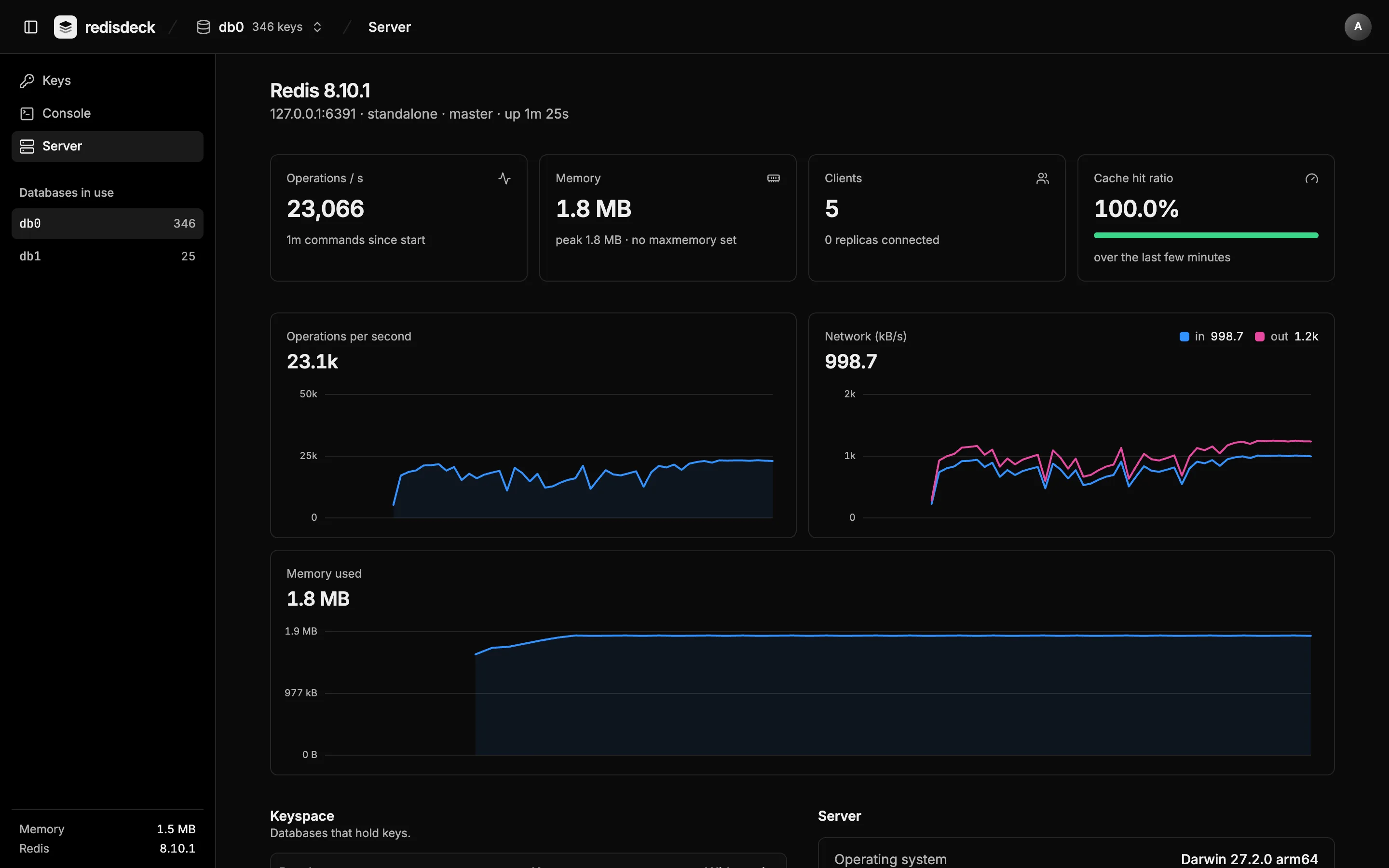
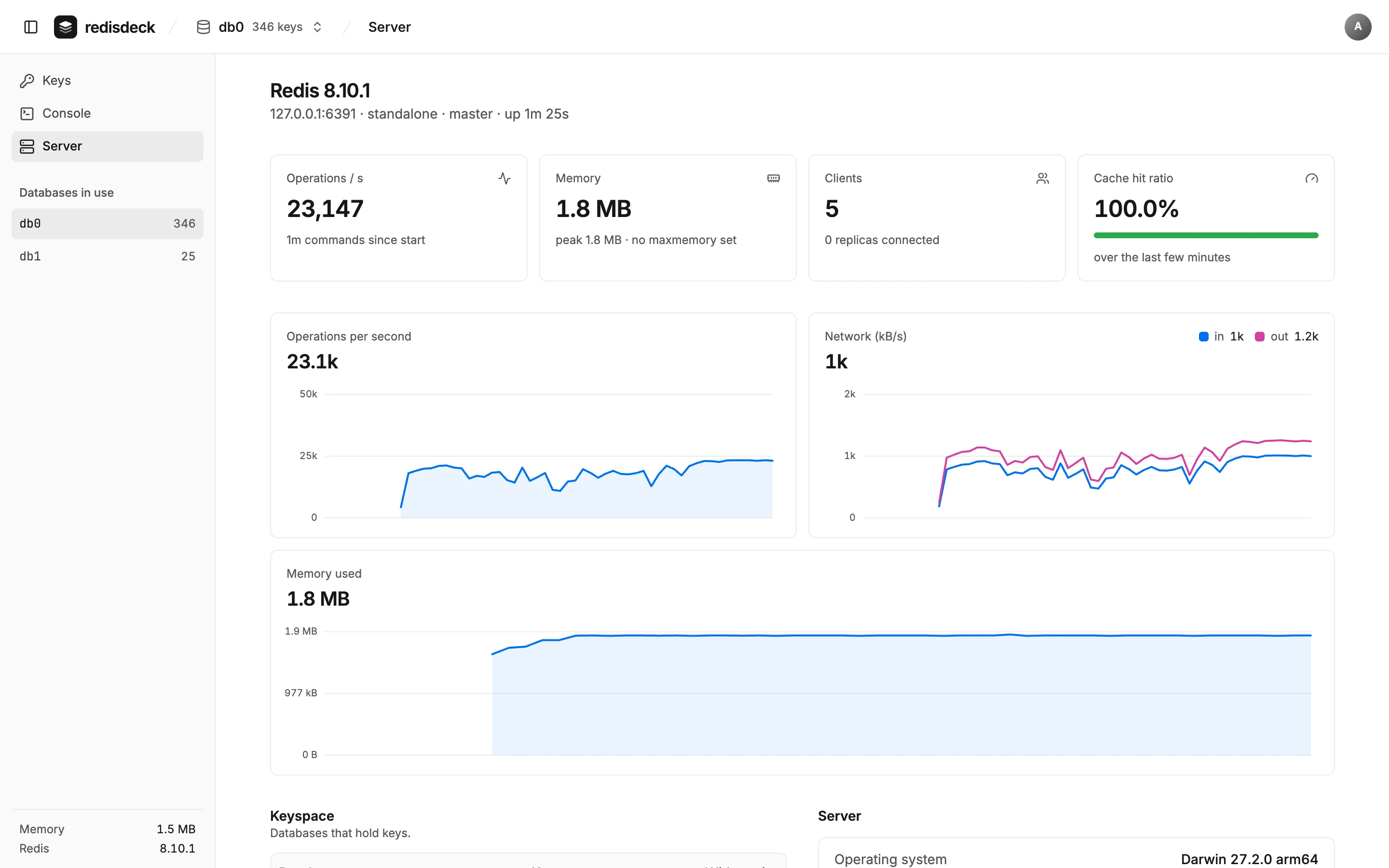
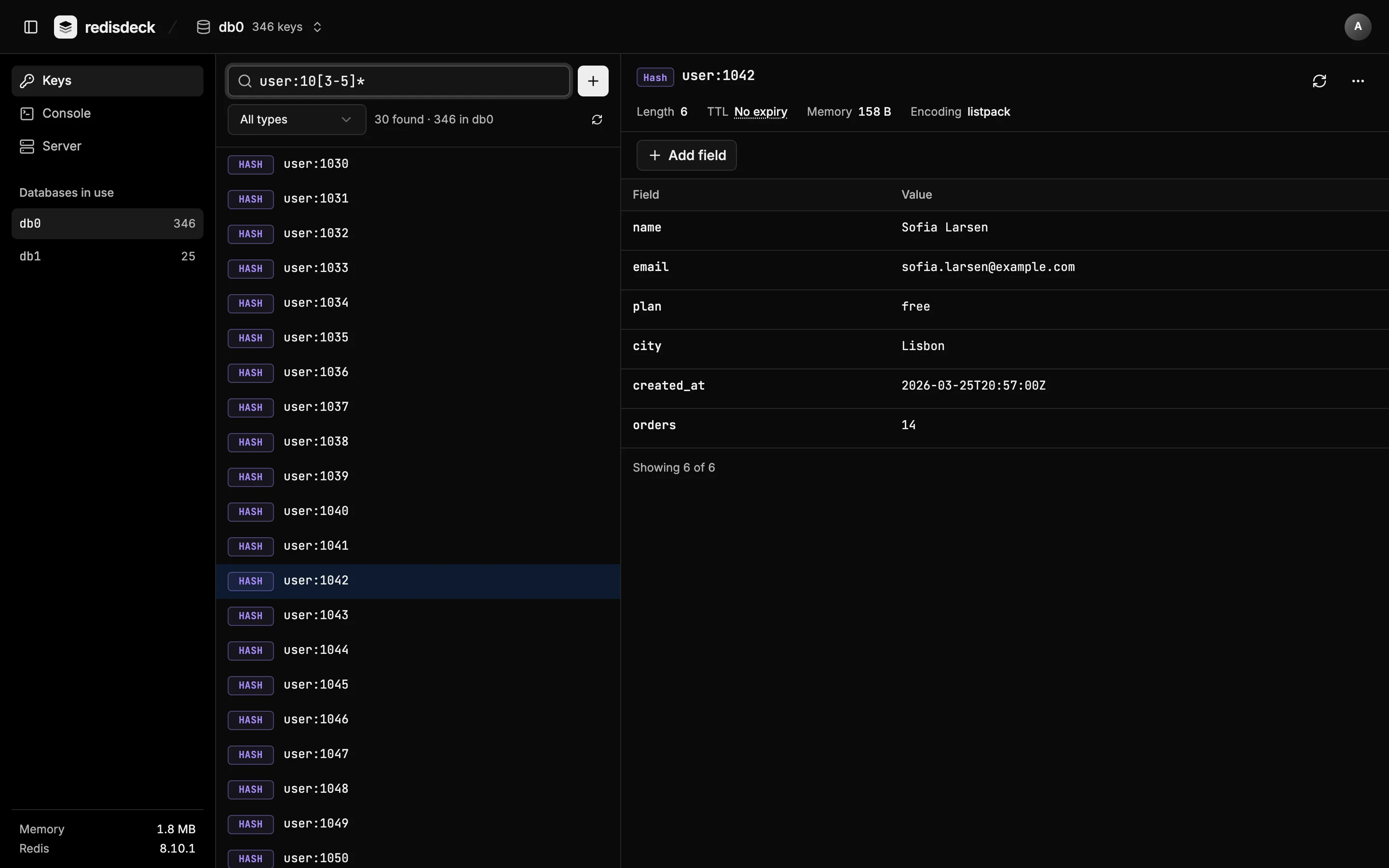
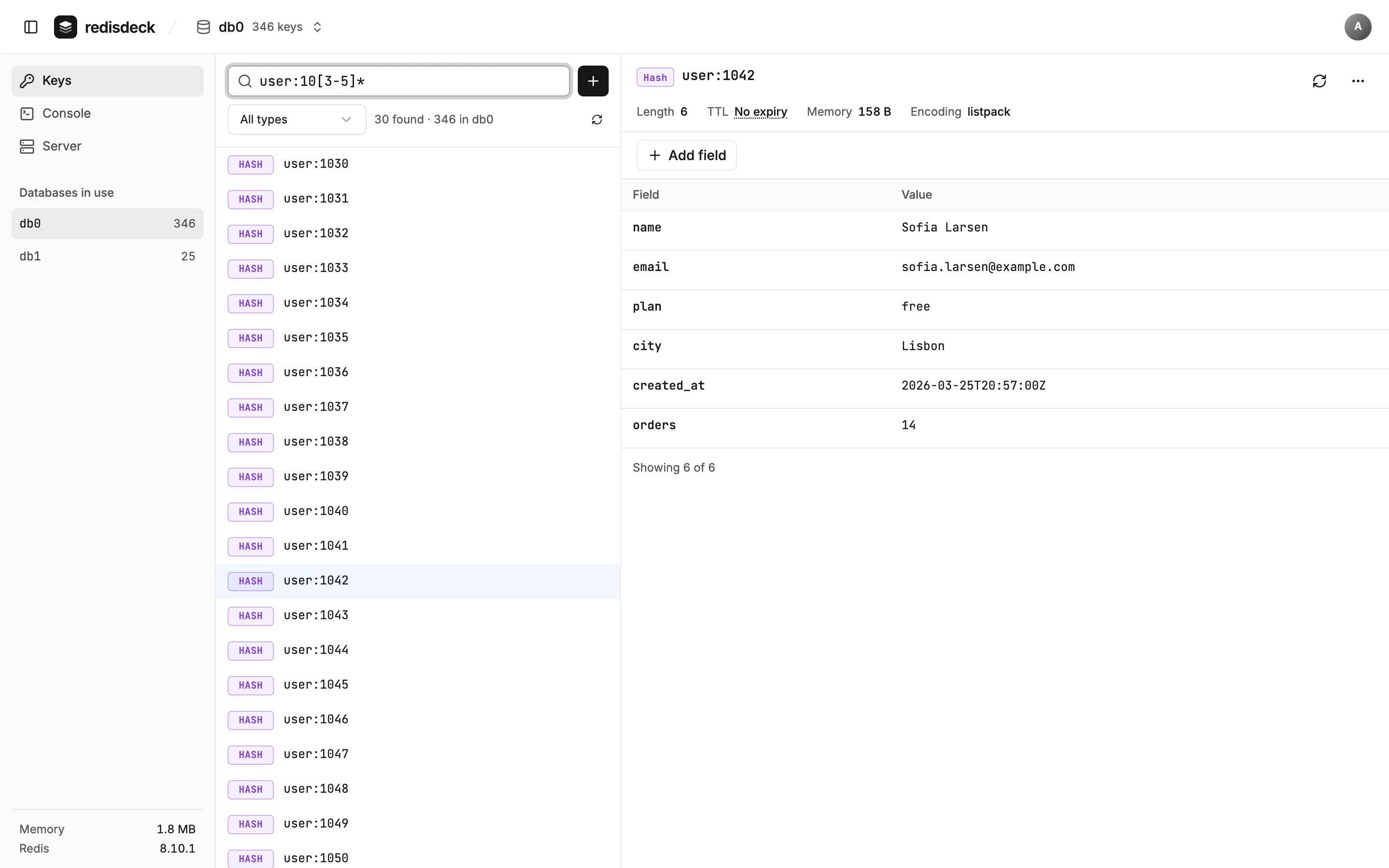
Filter keys by pattern and open one: every field of a hash in a table you can edit in place.
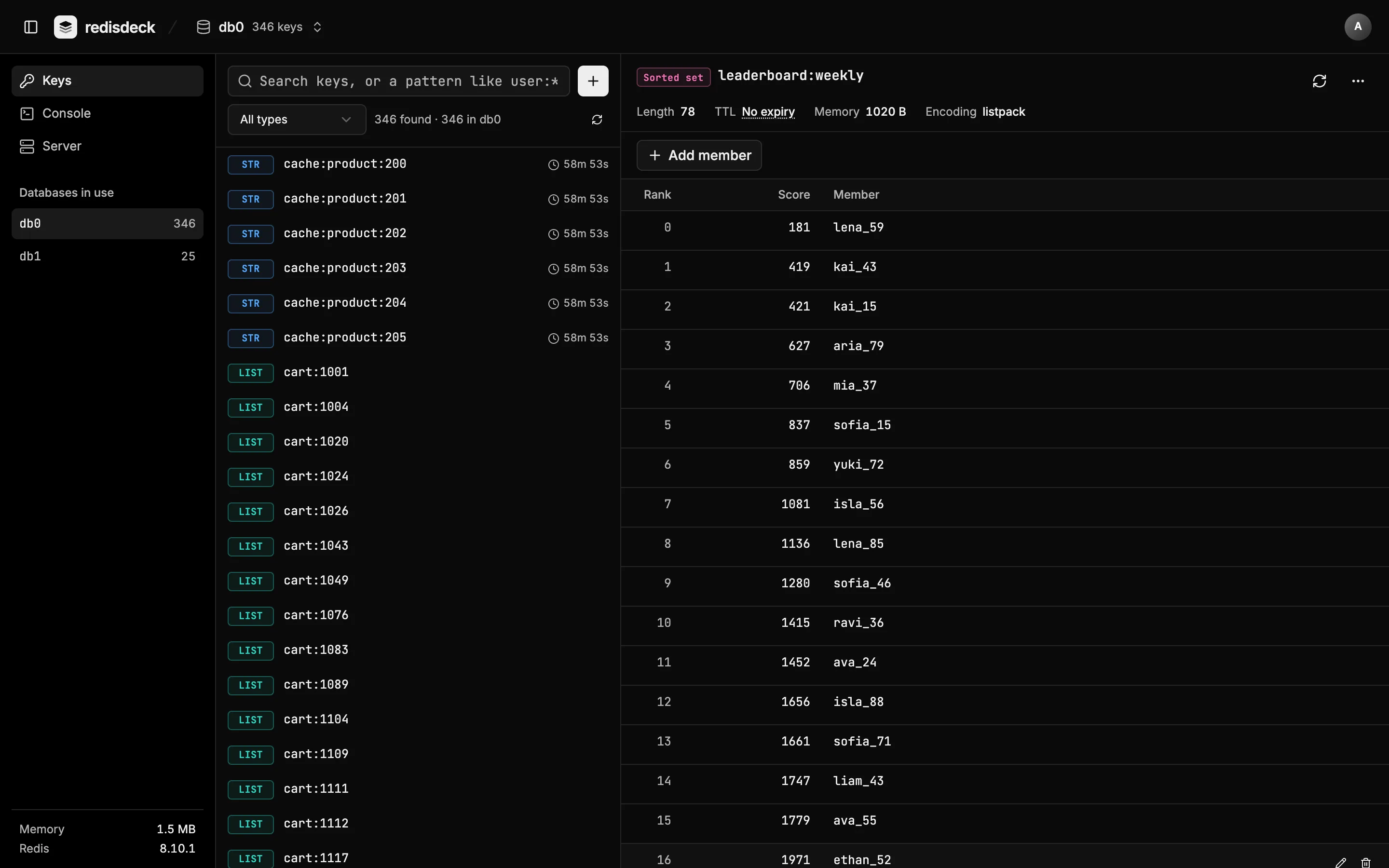
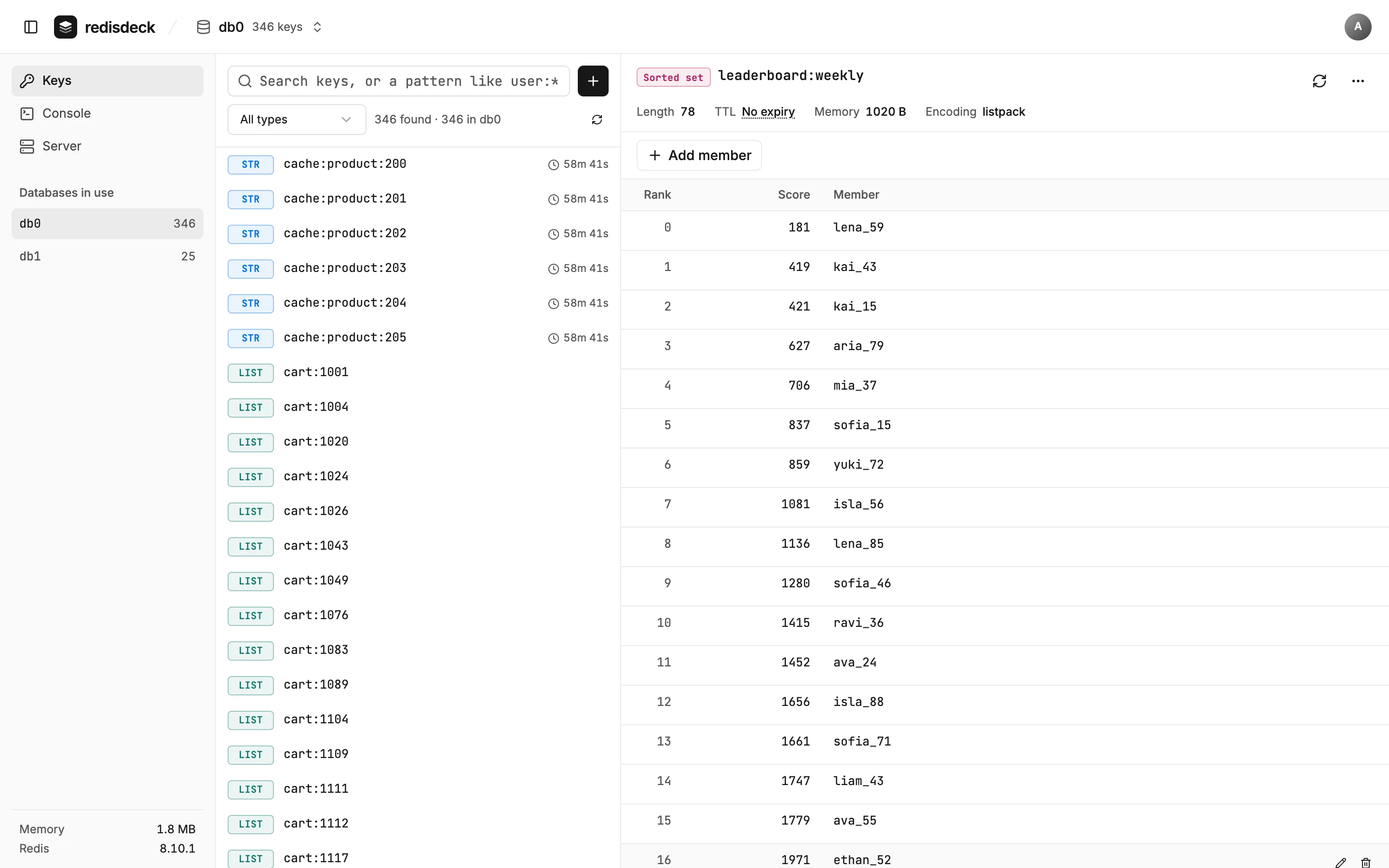
Members ranked by score, with length, memory and encoding up top. Add, rescore and remove members.
Newest entries first, each with its ID and fields. Add entries straight from the UI.
Strings that look like JSON can be formatted for editing, then saved back exactly.
Run any command against the current database. Replies look the way redis-cli prints them.
Live operations per second, network and memory, with clients and cache hit ratio at the top.
Run it next to your Redis.
On your laptop for a local Redis. On a server behind an SSH tunnel or a reverse proxy for everything else. It works at the root of a domain or under a path.
- --readonly
- Refuse every edit and write command
- --password
- A fixed login instead of a random one
- --host 0.0.0.0
- Listen beyond localhost
- --base-path /redis
- Serve under a path prefix
- --tls-insecure
- rediss:// without certificate checks
# Local Redis on the default port, opens your browser
npx redisdeck --open

# With a password, opening database 2
npx redisdeck redis://:secret@localhost:6379/2

# Managed Redis over TLS, read-only
npx redisdeck rediss://default:secret@cache.example.com:6380 --readonly
# On the server: redisdeck stays private on 127.0.0.1
npx redisdeck "$REDIS_URL" --password "$SECRET"
# On your laptop: forward the port, then open http://127.0.0.1:47815
ssh -L 47815:127.0.0.1:47815 you@your-server# npx redisdeck "$REDIS_URL" --base-path /redis --password "$SECRET"
location /redis/ {
proxy_pass http://127.0.0.1:47815;
proxy_set_header Host $host;
proxy_set_header X-Forwarded-For $proxy_add_x_forwarded_for;
proxy_set_header X-Forwarded-Proto $scheme;
}# handle_path strips /redis, so start redisdeck without --base-path
example.com {
handle_path /redis/* {
reverse_proxy 127.0.0.1:47815
}
}Login by default
A random password at every start, HTTP-only SameSite=Strict sessions, and rate-limited sign-in.
Private unless you say so
Binds to 127.0.0.1. Reach it through an SSH tunnel or a reverse proxy.
Cross-site safe
Every API call needs a custom header, so other sites can’t act on your behalf.
Least privilege
redisdeck can only do what its user can. Connect as a read-only ACL user for anything sensitive.
Point it at Redis and press Enter.
It prints a link and a password. Open the link. That’s the setup.
npx redisdeck redis://localhost:6379